| |
Stanley Park Explorer | Search About the Site Home |
| Month View < | Field Notes | BACK | |
|
| March 3 | Previous | Next | |
|
| |
Places to Visit and Explore Nature in Stanley Park Ecosystem Guides: Lake 
Stanley Park Visitor Map: with Park Features, Trails, and Destinations Lost Lagoon 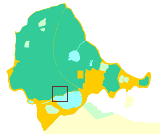
|
|

Greater Scaup One of Stanley Park's great wildlife spectacles is the arrival of large numbers of scaup on Lost Lagoon in late winter. Although small numbers of scaup can be found on Lost Lagoon throughout the winter months (Dec-Feb). Early Marsh sees the arrival of the first of the large flocks of scaup on Lost Lagoon. Two species of scaup, greater and lesser, begin to stage in the waters around Stanley Park as part of their northward migration. Both scaup species feed primarily in the ocean but return to the sheltered water of Lost Lagoon to rest, preen, and sleep. The exact timing of their departures and arrivals remains a small mystery (to me), although the cycle of the tides likely plays a large role, along with the weather, and the coming of night. The daily assembly of scaup on Lost Lagoon usually begins sometime after 3:30 PM when the small flocks that have been out foraging around Burrard Inlet return to the Lagoon. They typically arrive from the east, fly over the Stanley Park causeway, lose altitude, turn, and settle on Lost Lagoon. With the arrival of each new flight, the large raft of scaup on the Lagoon grows, spreads, twists and turns as though it is a single living organism. Sometime in early morning the process is reversed as the scaup leave the Lagoon to forage in small groups around Burrard Inlet. It appears that not all birds leave at the same time, so even if I arrive a little late, I can usually watch as a group of birds (related?) give signs that they are about to take flight. Heads shaking up and down on necks stretched up straight are a signal that a group of scaup is about to leave. These smaller, foraging parties tend to consist of from 30-90 birds (estimated). In past years, as many as three to four thousand scaup would spend the night on Lost Lagoon, so many in fact, the it would appear as though the Lagoon had a living carpet of birds. Such large flocks of birds attract the attention of predators and two species hunt the scaup from different vantage points. Bald eagles attack from the air and river otters hunt from below the water surface. Field Guide Entry: Greater Scaup |
|
|
|
| |
Stanley Park Explorer http://www.stanleyparkexplorer.ca Produced by Peter Woods naturalist@stanleyparkexplorer.ca Revised: May 20, 2011 |
|